
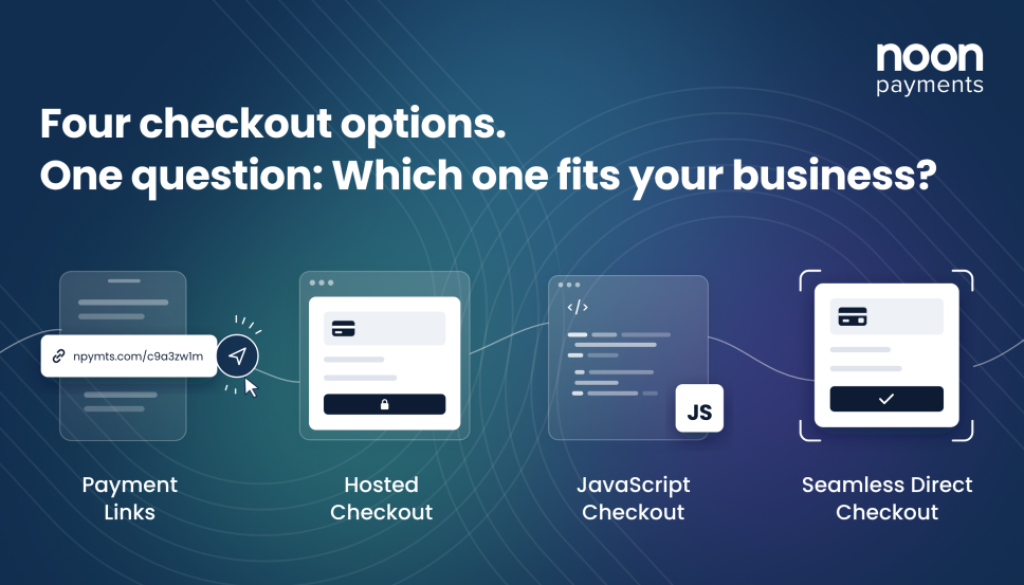
Payment Links vs Hosted Checkout vs JavaScript Checkout vs Seamless Direct Checkout: Which One Fits Your Business?
Choosing how customers pay online is an important decision for any business. Should you simply share a payment link? Redirect customers to a secure hosted payment page? Keep the payment form directly on your website using JavaScript? Or build a fully customized payment experience using a direct integration?
The right approach depends on your business model, technical resources, customer experience goals, and compliance requirements.
For businesses operating in the UAE, Saudi Arabia, and Egypt, the choice also needs to account for the region’s diverse payment landscape. Customers may expect to pay with international cards such as Visa and Mastercard, local payment methods such as mada and Meeza, domestic payment options such as Jaywan and Aani, digital wallets such as Apple Pay, Samsung Pay, and Google Pay, and Buy Now, Pay Later (BNPL) options where available.
A checkout experience that is convenient, mobile-friendly, secure, and built around the payment methods your customers use can help businesses create a smoother path from product discovery to completed payment.
This guide explains the four main ways businesses can accept online payments with noon payments and how to choose the approach that fits your business today while allowing you to scale in the future.
The Four Checkout Approaches Explained
Payment Links: The Fastest Way to Accept Payments
Payment Links are one of the simplest ways to start accepting online payments.
A Payment Link is a shareable URL that takes customers to a ready-made payment page. You don’t need to build a full online checkout or develop a payment form on your website.
With noon payments, merchants can generate Payment Links from the merchant dashboard and share them through channels such as:
- SMS
- Social media
- Direct messages
This makes Payment Links particularly useful for small businesses, service providers, freelancers, social sellers, and businesses testing a new product or service.
For example, a business selling through Instagram can send a customer a Payment Link directly after confirming an order. The customer can open the link, complete the payment, and the merchant can manage the transaction without needing a fully developed e-commerce website.
Best suited for: Businesses that want to start accepting online payments quickly without building a technical checkout.
Hosted Checkout: A Ready-Made Online Payment Experience
Hosted Checkout provides customers with a payment page managed by the payment provider.
Instead of building and maintaining the payment experience yourself, your website or application directs the customer to the hosted payment experience to complete the transaction. Depending on the integration, the payment experience can also be presented using options such as an iFrame or lightbox.
Hosted Checkout is a practical option for businesses that have an online store or application but don’t want to build a payment interface from scratch.
With noon payments, merchants can use a responsive payment experience designed to work across desktop and mobile devices while relying on the payment provider for key payment-processing and security capabilities.
This approach can reduce the technical work required compared with building a fully customized payment flow.
Best suited for: Growing e-commerce businesses that want a professional payment experience without developing and maintaining the entire payment interface themselves.
JavaScript Checkout: A Seamless Experience with Hosted Payment Fields
JavaScript Checkout sits between a traditional hosted checkout and a fully direct integration.
With JavaScript Checkout, the payment experience can appear directly within your website’s checkout page rather than sending customers to a separate payment page. At the same time, sensitive card information is handled through hosted payment fields rather than being processed directly by your own systems.
From the customer’s perspective, the experience can feel like a natural part of your website:
- The payment form appears within your checkout page.
- Customers can complete payment without a full-page redirect.
- Your website’s branding and checkout journey remain consistent.
- Hosted payment fields help keep sensitive card information away from your own systems.
This makes JavaScript Checkout suitable for businesses that want more control over the customer experience without taking on the same payment-data responsibilities associated with a fully direct integration.
The exact PCI DSS responsibilities depend on how the integration is implemented, so merchants should confirm their applicable compliance requirements with their payment provider and PCI DSS advisor.
Best suited for: Businesses that want a more seamless, on-page payment experience while using hosted payment fields.
Seamless Direct Checkout: Maximum Control and Customization
Seamless Direct Checkout gives businesses the greatest level of control over the payment experience.
With noon payments, this can be implemented through Direct Integration using the Web Services API, allowing a merchant’s development team to build the payment flow within its own website or application.
This approach can provide greater control over:
- Checkout design and user experience
- Payment flow
- Error handling
- Payment status management
- Integration with internal systems
- The overall customer journey
However, this greater control also comes with greater technical responsibility. Depending on the implementation, merchants may handle sensitive payment data directly and therefore have additional PCI DSS compliance obligations.
For this reason, direct integration is generally more appropriate for businesses with dedicated technical resources and the required compliance framework.
Best suited for: Established or scaling businesses that need extensive control over their payment experience and have the technical and compliance capabilities to support a direct integration.
Payment Links vs Hosted Checkout vs JavaScript vs Direct Checkout
The four approaches solve different business needs. The right choice depends on several factors.
| Approach | Best suited for | Technical effort | Customer experience | Customization |
| Payment Links | Social sellers, small businesses, quick payment collection | Very low | Simple and convenient | Limited |
| Hosted Checkout | Growing online businesses | Low to moderate | Professional, provider-managed | Moderate |
| JavaScript Checkout | Businesses wanting an on-page payment experience | Moderate | Seamless and on-brand | High |
| Seamless Direct Checkout | Scaling businesses with technical resources | High | Fully integrated | Very high |
How to Choose the Right Checkout Approach
1- Consider Your Development Resources
Your technical capacity is one of the first things to consider.
Payment Links require little to no development work, making them suitable for businesses that want to start accepting payments immediately.
Hosted Checkout requires an integration but removes much of the work involved in creating and maintaining a payment interface.
JavaScript Checkout requires more frontend integration because the payment experience is incorporated into your website.
Seamless Direct Checkout requires the most technical involvement because your development team has greater responsibility for the payment flow and integration.
Choose an approach that your team can implement, test, monitor, and maintain effectively.
2- Think About the Customer Experience
The payment experience is part of your overall customer journey.
Payment Links provide a straightforward way to collect payments, particularly when selling through social media or direct communication.
Hosted Checkout provides a ready-made payment experience, although the customer may move from your website to a provider-managed payment page.
JavaScript Checkout keeps the payment experience within your checkout page, helping maintain greater continuity with your brand.
Direct Checkout gives you the highest level of control over the payment journey and interface.
The right level of customization depends on how important the checkout experience is to your business and how much control your team needs.
3- Consider Your Business Stage
Your checkout requirements can change as your business grows.
Starting out: Payment Links can help you begin accepting payments without investing in a full technical checkout.
Growing: Hosted Checkout can provide a structured payment experience as your online sales increase.
Scaling: JavaScript Checkout can provide a more seamless experience while using hosted payment fields.
Established: Direct Checkout can provide greater control when you have the technical resources and compliance capabilities required for a customized integration.
This doesn’t mean every business needs to move through all four stages. You can choose the approach that fits your business model and requirements.
Supporting Local and International Payment Methods
Payment preferences vary across the region, so businesses need to consider which payment methods their customers use.
Depending on the market and merchant setup, customers may expect options such as:
- mada in Saudi Arabia
- Meeza in Egypt
- Jaywan in the UAE
- Aani in the UAE
- BNPL options, where available
The payment methods available to a merchant can depend on factors such as the market, merchant setup, integration, and payment-provider configuration.
With noon payments, businesses can access a range of local and international payment methods across the UAE, Saudi Arabia, and Egypt, helping them build payment experiences around their customers’ preferences.
The important consideration is not only which checkout approach you choose, but also whether the integration supports the payment methods your customers need.
Security and Compliance
Security is an essential part of any online payment experience.
PCI DSS
The Payment Card Industry Data Security Standard (PCI DSS) establishes security requirements for organizations that store, process, or transmit payment card data.
Using hosted payment pages or hosted payment fields can help reduce the amount of sensitive card data that passes through a merchant’s own systems. However, merchants should not assume that an integration automatically removes all PCI DSS responsibilities.
The applicable requirements depend on the specific integration and how payment data flows through the merchant’s environment.
Authentication and payment security
Online payments may also require additional authentication and security measures depending on the transaction, payment method, and applicable requirements.
A payment provider can manage important parts of the payment-processing and security infrastructure, while merchants remain responsible for the security of their own websites, applications, systems, and integrations.
Tokenization
Tokenization can replace sensitive card information with a secure token that can be used for subsequent payment-related processes without exposing the original card number.
For businesses offering saved cards, recurring payments, subscriptions, or other repeat-payment experiences, tokenization can be an important part of the payment infrastructure.
FAQs:
What is a Payment Link?
A Payment Link is a shareable URL that takes customers to a payment page where they can complete a transaction. With noon payments, merchants can create Payment Links from the merchant dashboard and share them through channels such as WhatsApp, Instagram, email, or SMS.
What is Hosted Checkout?
Hosted Checkout is a payment page managed by the payment provider. Customers are directed to the hosted payment experience to complete their transaction and may then be returned to the merchant’s website or application. With noon payments, Hosted Checkout can be implemented using options such as redirect, iFrame, or lightbox, depending on the integration.
What is JavaScript Checkout?
JavaScript Checkout allows merchants to present payment fields directly within their website’s checkout experience while using hosted payment fields to handle sensitive card information.
What is Seamless Direct Checkout?
Seamless Direct Checkout provides businesses with greater control over the payment experience through a direct integration. With noon payments, merchants can use Direct Integration through the Web Services API to build and manage a customized payment flow.
What is the difference between Hosted Checkout and JavaScript Checkout?
Hosted Checkout uses a provider-managed payment page, which can involve redirecting the customer away from the merchant’s website. JavaScript Checkout can display hosted payment fields directly within the merchant’s checkout page, creating a more seamless experience while sensitive card data is handled through the hosted fields.
Can I accept mada and other local payment methods with noon payments?
Payment method availability depends on the market, merchant setup, and integration. noon payments supports a range of local and international payment methods across the UAE, Saudi Arabia, and Egypt, including methods such as mada, Meeza, Jaywan, Aani, Visa, American Express, Mastercard, and supported digital wallets and BNPL options.
Can I change my checkout approach as my business grows?
Yes. Your payment integration can evolve as your business requirements change. A business may start with Payment Links, move to Hosted Checkout as it launches an online store, adopt JavaScript Checkout for a more seamless experience, or implement Direct Checkout when greater customization and control become necessary.
Get notified with blog updates