
Clearing vs. Settlement: What’s the Difference and Why It Should Matter to You
You make a sale. Your portal shows a completed transaction, you provide the product or service, the customer walks off happy. Then, nothing happens in your bank account for a day or two. Sometimes three.
If you’ve ever wondered where the money actually goes in that gap, you’ve stumbled into the two most misunderstood words in payments: clearing and settlement. People use them interchangeably. They’re not the same thing, and the difference actually explains a lot about why your settlements behave the way they do — especially if you’re running a business across the UAE, Saudi Arabia, or Egypt, where cards, wallets, and local schemes all move at slightly different speeds.
What is clearing?
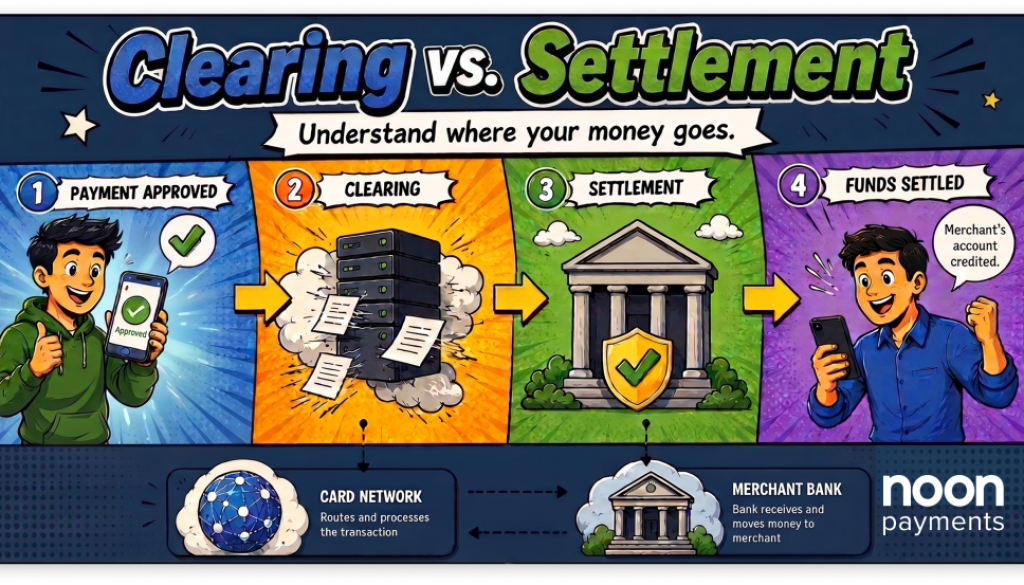
Clearing is the verification step. It’s when the bank that issued the customer’s card (the issuer) and the bank that processes your payment (your acquirer) exchange transaction details — checking the card is real, the funds exist, and the transaction matches what was authorized. The card scheme, whether that’s Visa, Mastercard, mada, or Jaywan, sits in the middle coordinating the exchange.
Nothing moves yet at this stage. Clearing just confirms that the transaction is legitimate and tells everyone involved how much they owe whom. Think of it as the paperwork being signed off before the cheque is actually written.
It also happens fast. In most cases, clearing wraps up within minutes of the purchase. That’s why your dashboard can show “approved” almost instantly, even though your bank balance hasn’t moved an inch.
What is settlement?
Settlement is when the money actually moves. Once clearing confirms a transaction is good, settlement is the process of transferring funds from the customer’s bank to your acquirer, and ultimately into your merchant account.
This is the part merchants actually feel. Clearing is invisible — it happens in the background between institutions. Settlement shows up as a deposit.
And settlement is where the timing gets less predictable. A few things affect how fast it happens:
- Batching. Many banks group transactions together and settle them at set intervals rather than one by one, since processing in batches is cheaper. This is the most common reason for a one-to-three day gap between a sale and a payout.
- Compliance checks. Anti-money-laundering screening and risk reviews can add time, particularly for higher-value or first-time transactions.
- Payment method and country. A mada debit transaction in Saudi Arabia, a Meeza payment in Egypt, and a Visa card in the UAE don’t always sit on the same settlement rails — local schemes often settle differently than international card networks.
- Technical or banking-hours delays. Settlement that happens to land on a weekend or a public holiday in any of the three markets will simply wait until the next business day.
Some real-time payment rails skip all of this, such as Aani or Al Tareq in the UAE. With real-time gross settlement (RTGS), clearing and settlement happen almost simultaneously, and the recipient gets usable funds immediately. It’s the exception, not the rule — but it’s where the industry is heading.
Clearing vs. settlement: the key differences
| Clearing | Settlement | |
| What it does | Verifies the transaction and confirms who owes what | Actually, transfers the money |
| When it happens | Immediately after the transaction, usually within minutes | After clearing, often 1-3 days later |
| Who’s involved | Issuer, acquirer, card scheme | Issuer’s bank, acquirer’s bank |
| What you see | An “approved” or “completed” status | A deposit in your merchant account |
| What slows it down | Rarely delayed – it’s fast by design | Batching, compliance checks, banking hours, scheme-specific rules |
The short version: clearing answers “is this transaction valid?” Settlement answers “where’s my money?” Every payment goes through both, in that order, every time.
Why this confuses so many merchants in the region
This isn’t just semantics. Misunderstanding the gap between clearing and settlement causes three very real headaches for merchants operating across the UAE, KSA, and Egypt:
Cash flow forecasting goes wrong. If your finance team assumes “approved” means “in the bank,” your projected cash position will be consistently off — and that gap compounds when you’re running promotions or seasonal spikes where transaction volume jumps overnight.
Reconciliation gets messy across markets. A merchant accepting Visa in Dubai, mada in Riyadh, and Meeza in Cairo is effectively managing three different settlement rhythms under one P&L. Without clear visibility, “why doesn’t this payout match yesterday’s sales report” becomes a recurring support ticket.
Chargebacks and disputes get misattributed. A dispute can affect a transaction that’s cleared but not yet settled, which means the funds you’re disputing might not even have landed yet. Knowing where a transaction sits in the lifecycle changes how you respond.
None of this is a flaw in the system. It’s just how multi-market payments work. The fix isn’t avoiding it — it’s having a payment partner who makes the gap visible instead of leaving you to guess.
How noon payments handles this for you
This is exactly the gap noon payments was built to close. As your payment gateway across UAE, Saudi Arabia, and Egypt, we give you clear, real-time visibility into where every transaction stands — from the moment it’s processed through to when your acquirer settles the funds — instead of leaving you to piece that picture together yourself.
In practice, that means:
- One dashboard, every market. Track transactions across cards (Visa, Mastercard, American Express, JCB and more), local debit schemes (Jaywan, mada, Meeza), and digital wallets (Apple Pay, Samsung Pay, Google Pay) in a single view, instead of stitching together reports from multiple processors.
- Clear, complementary reporting. We provide real-time transaction reporting so you can see exactly what’s been processed on our end; your acquirer’s settlement report then confirms when those funds have actually moved.
- Built-in fraud monitoring. Every transaction is screened continuously, which means fewer surprises further down the line.
- Local expertise, not a one-size-fits-all rail. We work closely with acquiring partners in each of our markets, which means the reporting you get reflects how each country’s banking infrastructure actually works — not a generic global default.
If you’re expanding across the UAE, Saudi Arabia, and Egypt and currently juggling separate providers just to see where your transactions stand, this is usually the first thing to simplify.
FAQs:
Is clearing the same as settlement?
No. Clearing verifies a transaction is valid and calculates what each party owes. Settlement is the actual transfer of funds. Clearing happens first and is fast; settlement happens after and can take longer.
How long does it take for a payment to settle after it clears?
Typically between one and three business days, though this depends on the payment method, the banks involved, and whether the transaction falls on a weekend or public holiday in that market.
Why hasn’t my “approved” transaction shown up in my bank account yet?
Because approval reflects clearing, not settlement. The transaction has been verified, but the funds haven’t been transferred yet. This is normal and expected, not a sign of an error.
Does settlement speed differ between UAE, KSA, and Egypt?
Yes. Local payment schemes (such as mada in Saudi Arabia or Meeza in Egypt) and local banking infrastructure can settle on different timelines than international card schemes. A payment partner with local acquiring relationships in each market helps smooth this out.
Get notified with blog updates