
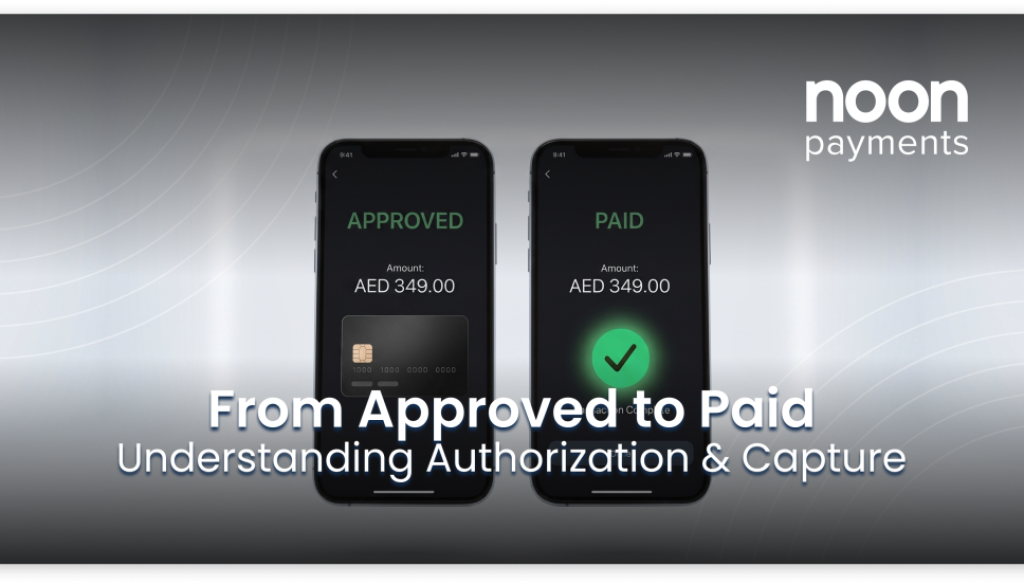
Payments Explained: Authorization vs Capture
How every card transaction moves from “approved” to “paid,” and how noon payments manages the process for merchants across the UAE, KSA and Egypt.
A successful card payment involves more than one step behind the scenes. Authorization and capture are two distinct stages in the payment process, and understanding the difference is essential for merchants managing payment reconciliation, cash flow, and pending transactions.
This guide breaks down authorization vs capture in plain terms, explains how the two-step flow works on a modern payment gateway, and shows how noon payments processes every order for merchants operating in the UAE, Saudi Arabia and Egypt.
What Is Payment Authorization?
Payment authorization is the real-time check that confirms a customer has sufficient funds or credit available for a purchase. It happens the moment a customer submits their card details at checkout: the payment gateway routes the transaction to the relevant card network, the card network forwards the request to the customer’s issuing bank, and the issuing bank responds with an approval or a decline — usually within a second or two.
An approved authorization places a temporary hold on the customer’s funds. It reserves the money so it can’t be spent elsewhere, but no money actually changes hands yet. This is why a customer can see a transaction “pending” on their bank statement before it’s actually charged.
What Is Capture in Payments?
Capture is the step where the merchant instructs the payment gateway to process the money movement that was previously authorized, moving the transaction toward settlement. Capture is what actually starts the transfer of money — it converts a reserved hold into a real charge.
Capture can happen in one of two ways:
- Immediately — authorization and capture happen back-to-back in a single step, often called a “sale” transaction.
- Later — the merchant authorizes first and captures separately, once an order is confirmed, packed, or shipped.
A merchant can also capture less than the originally authorized amount — useful when an order changes between checkout and fulfillment, such as an item going out of stock or a partial shipment.
Authorization vs Capture: Key Differences
| Aspect | Authorization | Capture |
| What it does | Confirms funds are available and places a temporary hold | Actually collects the held funds and moves them toward settlement to the merchant’s bank account |
| When it happens | At checkout, in real time, before the order is confirmed | Immediately after authorization, or later — when the merchant decides |
| Does money move? | No — funds are earmarked, not transferred | Yes — capture is what starts the transfer of funds |
| Who triggers it | The card network and the customer’s issuing bank, via the payment gateway | The merchant, either automatically or manually through the payment gateway |
| Can it be reversed? | Yes — an uncaptured authorization can be voided/reversed | Only through a refund, since funds have already moved |
Immediate Capture vs Delayed Capture: Which Should You Use?
Which capture method fits a business depends on how quickly an order can actually be fulfilled.
Immediate (automatic) capture: Sale
Authorization and capture happen in the same step. This suits businesses that deliver value instantly and don’t need a gap between payment and fulfillment:
- Digital products, subscriptions, and app or in-game purchases
- Instant services and on-demand bookings
- Most standard e-commerce checkouts where stock is guaranteed
- In KSA for mada, transaction success rates are higher for Sale
Delayed (manual) capture
Authorization and capture are separate steps, giving the merchant a window to confirm the order before money moves. This suits businesses where fulfillment isn’t instant:
- Retailers shipping physical goods, who prefer to capture only once an order ships
- Travel, hospitality and big-ticket purchases, where availability can change after checkout
- Made-to-order or custom goods, where stock needs to be confirmed first
Delayed capture reduces the risk of charging a customer for an order that ultimately can’t be fulfilled — and reduces refund volume and related disputes as a result.
What Happens If a Payment Isn’t Captured? Void, Reversal & Expiry
An authorization is not a charge, and it doesn’t last indefinitely. If a merchant never captures it, two things can happen:
- It expires automatically. Card networks and issuing banks release an uncaptured hold after a set window — commonly 5-7 days after the initial authorization transaction depending on the network.
- The merchant reverses it manually. If a merchant knows an order won’t be fulfilled — an item is out of stock, or a customer cancels — they can explicitly void or reverse the authorization on noon payments. This releases the customer’s funds faster than waiting for automatic expiry, which is better for the customer relationship and reduces support complaints about “blocked” money.
This is also why authorization and capture matter for chargeback and dispute management: a captured, settled transaction is refunded, while an uncaptured authorization is simply voided — the correct action depends on knowing which stage a transaction is in.
Conclusion:
Authorization and capture are two different moments in the same transaction: one confirms the money is there, the other actually collects it. Understanding the difference helps merchants choose the right capture method for their business model, manage cash flow more accurately, and give customers a cleaner, more trustworthy checkout experience.
noon payments handles both payment modes— immediate sale or authorize & capture— as part of a single, PCI DSS–compliant payment gateway built for merchants operating, with the flexibility to choose immediate or delayed capture depending on how each business fulfills orders.
FAQs:
What is the difference between authorization and capture in payments?
Authorization confirms funds are available and places a temporary hold on them. Capture is the separate step that actually collects those funds and moves them toward settlement. Authorization doesn’t move money; capture does.
Does a payment authorization mean I’ve been charged?
No. An authorization only reserves funds against a customer’s available balance. The customer is only actually charged once the merchant captures the transaction.
How long can a transaction stay authorized before it needs to be captured?
It depends on the card network and issuing bank, but uncaptured authorizations are typically released automatically within a window of 5-7 days, if the merchant doesn’t capture or void them sooner.
Can a merchant capture less than the amount that was authorized?
Yes. Partial capture lets a merchant collect less than the original authorized amount — useful when an order changes between checkout and fulfillment, such as a partial shipment.
What role does a payment gateway play in authorization and capture?
A payment gateway like noon payments routes the authorization request to the card network and issuing bank, manages 3D Secure authentication, and lets the merchant trigger capture — automatically or manually — while working with licensed acquiring partners to complete settlement into the merchant’s account.
Get notified with blog updates